In Cambodia, as in many countries across Asia, there is a long tradition of mediation. Disputes are traditionally resolved by negotiation and compromise, rather than through an adversarial legal process. Respected elders, Buddhist monks, and local authorities at the village and commune levels, have historically worked to resolve disputes outside the judicial system.
The traditional conflict management system used by Cambodian villagers to resolve daily disputes is a process known in Khmer as somrohsomruel and has ancient roots in Khmer society. Under this system, a preference for avoiding disclosure of problems led to an attempt to settle matters individually, or with the help of close relatives or neighbors, before calling on an independent third party to resolve a dispute through mediation.
This traditional mediation process usually began at the village level. Only when the dispute was not resolved would it move up a hierarchical ladder, first to the commune, and then to the police, district or court. Although procedures varied, depending on the locality, the basic framework and its key steps, sequence of events and the individuals involved followed a general pattern: When one or both parties demanded mediation, a village chief would arrange a meeting. The parties were then summoned to the chief’s house or to the site of the dispute. Some village chiefs would agree to the presence of elders and family members.
The chief would then ask the parties to provide their side of the story. He might even ask other people to clarify the situation. The chief would then try to calm things down and would either ask both parties to find a mutually satisfying solution or impose his decision upon them. There were no regulated dispute management procedures to speak of. Each chief had a personal method for resolution, based on individual experience and knowledge.
The model of mediation developing in Cambodia today includes aspects of the traditional model and incorporates the mediation experience of commune dispute resolution committees, with a specific focus on appropriate settlement mechanisms for local practices. For example, small civil disputes involving issues, such as debts, contracts, land borders, farms and slander may be mediated at the local commune council level through the government’s Justice Service Centers (JSC).
The Ministry of Justice’s Mediation and Local Justice Department, in collaboration with non-governmental organizations, such as the Cambodian Center for Mediation (CCM), trains JSC officials in the use of modern mediation methods and techniques. This training builds JSC officials’ mediation capacity, as well as educates participants about the role of mediation in the legal system. Ultimately, the goal is to establish a culture of mediation across the country, and improve access to justice for Cambodian citizens, through the coordination of formal and non-formal mediation processes.
By Savath Meas, Senior Fellow-Cambodia, Weinstein International Foundation.
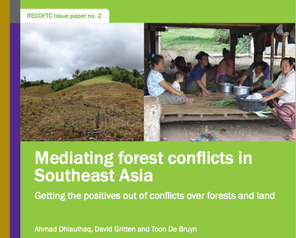
Mediating forest conflicts in Southeast Asia: Getting the positives out of conflicts over forests and land.
www.recoftc.org
Management of local conflicts in Cambodia.
An anthropological approach to traditional
and new practices.
unesdoc.unesco.org
INTRODUCTION
The Cambodian Centre for Mediation (CCM) was founded in 2010 as an independent and nonprofit organisation and a registered first national organisation in Cambodia specifically working in the area of alternative dispute resolution through mediation to promote peaceful and equitable resolutions of conflict, by providing high quality mediation services, training and education for the community, civil society and government, skills development and a variety of consultancy services in the fields of conflict assessment, conflict transformation strategies and methodologies, facilitation and mediation, and ADR development. CCM works in partnership to support local peace building, conflict resolution initiatives, and mediation and local justice with NGOs and government whose over 500 mediators were trained to address the growing numbers of local conflicts in Cambodia. Mediators Beyond Borders International (MBB) is a US based NGO and founded in 2006 by a group of visionary mediators and its mission is to build local capacities for peace and promote mediation worldwide. MBB does this by enhancing local capacity upon invitation, advocating for mediation in all arenas and providing consultancy services that promote peaceful conflict resolution.
Project Background and Objectives
The MBB Dialogue Process Project (DPP) is partnering with the Cambodian Center for Mediation (CCM) to gather information for an assessment report. If the assessment is successful and funding can be obtained, the MBB and CCM plan to followup with consensus building dialogue facilitator training and ongoing support for CCM to develop a pilot project. The project would bring together all stakeholder representatives (commune, government, concessionaire, etc.) in a particular land dispute, to facilitate a collaborative dispute resolution process. If the pilot is successful, the goal is to create incountry teams of Cambodian mediators who will use this process to resolve land disputes.
The need for the program is urgent as land use disputes have grown in intensity and potential violence as farmers, with or without formal title to land, face increasing development pressures and evictions by businesses that have been granted land concessions via the government. Many legal structures are in place, but the breakdown in balancing rapid economic growth with a traditional agrarian culture has resulted in unrest and distrust among farmers, business owners, communities and the government.
The team will be making an information gathering, assessment and process design visit to Cambodia from February 21-28, 2016 and plans to follow-up with consensus building dialogue facilitator training and ongoing support for CCM. The goal is to create in-country teams of Cambodian mediators who will eventually seek to resolve land disputes in all 25 Cambodian Provinces and municipalities.
Assessment Team
1) Mrs. Rachel Wohl, MBB Team Leader
2) Mrs. Laura McGrew, MBB member
3) Mrs. Katherine Triantafillou, MBB member
4) Mr. Alan Gross, MBB member
5) Mr. Thorng Kakada, CCM member
6) Ms. Chea Muoy Kry, CCM member
7) Mr. Meas Savath, CCM member
8) Mr. Seang Samanagne, CCM member