
Following its establishment in 2010, CCM focused on building its institutional foundations by promoting mediation as a professional and credible alternative dispute resolution (ADR) mechanism. During this period, the organization established its governance structure, developed its initial mediation programmes, and began building public awareness of mediation and dialogue-based conflict resolution in Cambodia.
CCM expanded its partnerships with government institutions, civil society organizations, development partners, and professional networks to strengthen mediation awareness and institutional collaboration. The organization broadened its training programmes, community engagement, and advocacy efforts to promote mediation as an accessible and constructive approach to resolving disputes.
As Cambodia's social and economic landscape evolved, CCM diversified its programmes to respond to increasingly complex disputes. Its work expanded beyond community mediation to include commercial, financial, labour, family, land, organizational, and institutional disputes. During this period, CCM also strengthened its work in dialogue facilitation, conflict transformation, peacebuilding, policy engagement, and professional capacity development.
Building on more than a decade of experience, CCM focused on strengthening institutional quality, professional standards, and strategic partnerships. The organization enhanced mediator training and accreditation, developed institutional policies and operational frameworks, expanded research and knowledge-sharing initiatives, and advanced collaboration with national and international partners. Preparatory work also began for establishing Global Mediation Services (GMS) as CCM's specialized mediation service platform.
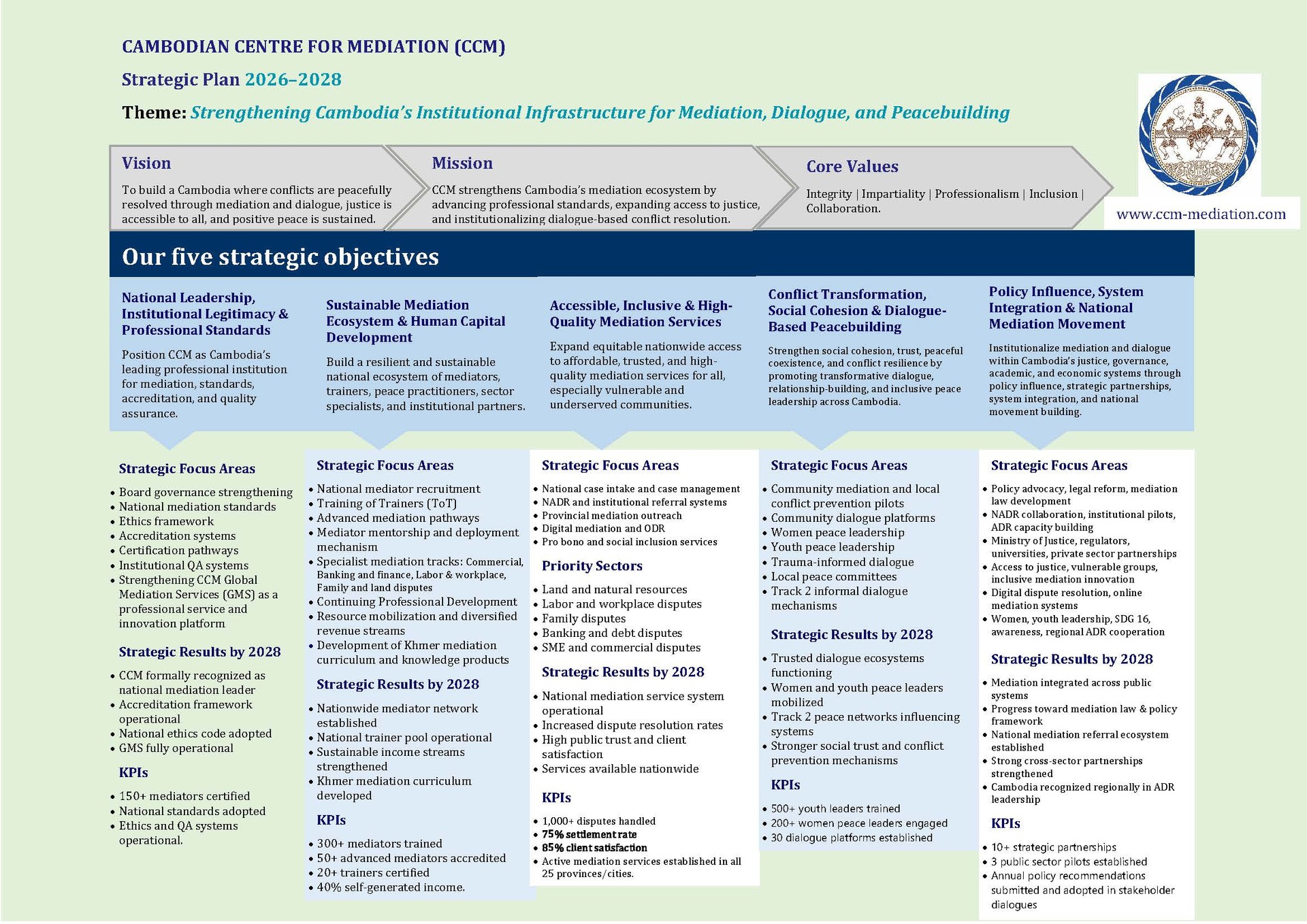
The Strategic Plan 2026–2028 marks a significant milestone in CCM's institutional development. Guided by the vision of "Strengthening Cambodia's Institutional Infrastructure for Mediation, Dialogue, and Peacebuilding," CCM is advancing its role as Cambodia's national institution for mediation by strengthening professional standards, expanding access to high-quality mediation services through Global Mediation Services (GMS), developing the next generation of mediators, promoting dialogue-based peacebuilding, and supporting policy and legal reform.
By 2028, CCM aspires to be nationally and internationally recognized as: